
How to Write an SEO Content Brief (With Template)
Turn a vague blog idea into a focused assignment your writer can deliver, with a reusable brief and a worked small-business example.
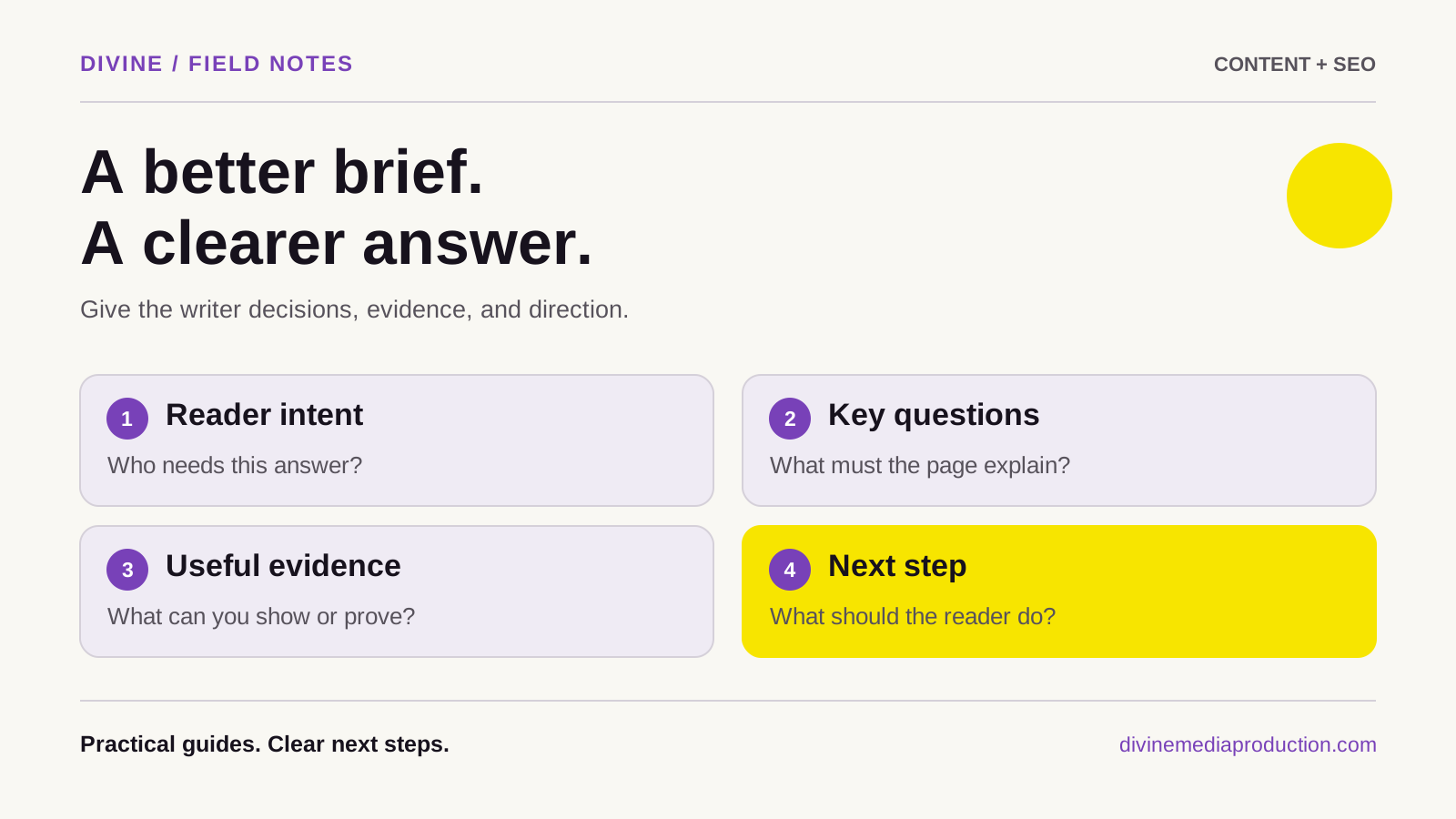
An SEO content brief is a writing plan that connects a reader's question with your business's knowledge. A useful brief identifies the audience, the decision they need to make, the evidence you can contribute, and the next step the page should support. Keywords belong in that plan, but a list of phrases alone will not give a writer enough direction.
You can prepare the brief below before writing in-house or commissioning an article. The aim is to resolve the important decisions early, so review focuses on accuracy and usefulness instead of rewriting an entire draft.
Start with the reader's job
Write one sentence describing what someone should be able to do after reading. Make it more specific than “learn about our service.” For example: “A Toronto business owner can prepare products, people, and locations for a first brand photography session.” That sentence gives the article a boundary.
Next, describe the reader's starting point. Are they comparing providers, preparing for a booked appointment, or diagnosing a problem? A first-time buyer needs definitions and examples. An experienced buyer may need a comparison, exceptions, or a decision framework. Trying to serve both equally often produces an article that explains too much and answers too little.
Add the business purpose separately: reduce avoidable questions, introduce a relevant service, or help a qualified prospect prepare. If you cannot explain why this topic belongs on your site, revisit your small-business content marketing strategy before assigning it.
Research intent before making an outline
Start with information you already have permission to use: recurring sales questions, anonymized support themes, and the explanations your team repeats. Ask the person delivering the service which misunderstandings cause delays. These conversations often reveal details absent from broad keyword lists.
Then review the search results for the main question and a few natural variations. Record what people appear to need: a checklist, a definition, a comparison, or a service provider. This is an editorial observation, not proof of search volume or a guarantee that matching a format will earn visibility.
If you have Search Console data, look for relevant queries and the pages already receiving impressions. A new site may have little useful data; label that gap instead of inventing demand. Choose a primary question and supporting questions that belong to the same task. Save unrelated ideas for another brief.
Choose one page and one clear angle
Check whether an existing article or service page already answers the question. Sometimes improving that page is more helpful than publishing another with a slightly different title. Record the chosen URL, the related existing pages, and what this assignment adds.
Your angle should come from a useful contribution: a preparation worksheet, an explanation of tradeoffs, a documented process, or an example from your actual work. “Longer than competing articles” is not an angle. Google explicitly says it has no preferred word count in its guidance on helpful content. Set an approximate length for budgeting and editing, then let the reader's task determine what stays.
Include an exclusion list. A photography preparation article might exclude equipment reviews, wedding photography, and pricing comparisons. Exclusions protect the draft from becoming an unfocused introduction to the entire industry.
Copy this SEO content brief template
Use these fields in a document or project task. Short, specific answers are more useful than several pages of instructions that contradict each other.
Scroll across to view all columns
| Field | What to record |
|---|---|
| Audience and situation | Who is reading, what they already know, and what prompted the search. |
| Reader outcome | The practical decision or task the page will help them complete. |
| Primary question | One main question, with natural search phrasing where useful. |
| Supporting questions | The necessary follow-ups, ordered by the reader's likely needs. |
| Distinct contribution | The experience, example, tool, or explanation your business can add. |
| Evidence and permissions | Approved sources, interview contacts, image rights, and claims needing review. |
| Scope and exclusions | What belongs here and what should be covered elsewhere. |
| Page plan | Proposed title, URL, headings, examples, and useful internal links. |
| Next step | One relevant action that fits the reader's readiness. |
| Review and ownership | Writer, factual reviewer, approver, deadline, and future review trigger. |
Worked example: a brand photography article
The following is an illustrative assignment for a fictional Toronto photography studio. It is a planning example, not a client story or evidence of results.
Audience, question, and outcome
Audience: an owner preparing for their first business photo session. Primary question: how to prepare for brand photography. Outcome: create a realistic shot list and have the necessary people, products, and permissions ready.
Business purpose: make preparation clearer and help readers understand what a planning conversation covers. Angle: organize the checklist around where the photos will be used, rather than beginning with clothing suggestions.
Source material and boundaries
Interview the photographer about preparation steps they actually use. Request an approved, anonymized sample shot list and a photo the studio owns or has permission to publish. Ask which requirements depend on the venue. Do not present a suggested schedule as a promise that every session takes the same time.
Exclude camera-buying advice and unsupported claims about sales generated by new photographs. Mention Toronto only where it affects planning, such as travel between locations or confirming permission to photograph at a particular property. Do not add neighbourhood names merely to repeat local keywords.
Outline and next step
- Choose the website, social, and print placements the images must support.
- Translate those placements into a short, prioritized shot list.
- Confirm people, products, locations, access, and permissions.
- Prepare wardrobe and props that suit the intended use.
- Agree on priorities and a fallback if something changes.
Finish with a preparation checklist and an invitation to discuss the reader's intended photo uses. That action follows naturally from the article; a generic demand to book immediately may not.
Give the writer decisions, not a script
Headings should show the route through the answer. Under each heading, specify the question to resolve, the example to include, and any claim that needs confirmation. Leave room for the writer to improve the explanation.
Include a short vocabulary note where customers and your team use different terms. Explain technical language on first use. Avoid demanding an exact keyword density or inserting the same phrase into every heading; those instructions can make the draft harder to read.
If the brief includes a video or image, describe its job. A diagram might explain a process; a photograph might show a finished deliverable. Identify the owner and permission status before production. Once the main article exists, the same verified source material can support repurposed video content without turning every format into a duplicate transcript.
Include page details without overpromising search display
Suggest a concise, descriptive title and a unique description that accurately summarize the page. Google may generate a different title link or snippet; the brief should not promise that your exact wording will appear. Its title guidance favours clear, distinct titles, while its snippet guidance explains that descriptions can come from the page itself.
Choose internal links because they help the reader continue. A preparation article might link to a relevant service and a useful example. Use descriptive link text rather than repeated “click here” instructions. Record these destinations in the brief so they do not become an afterthought.
Review the draft against the brief
Read once as the customer: can you complete the stated task without searching again for a missing step? Read again as the business: are prices, service boundaries, examples, and claims accurate? Verify permissions, source links, and the next-step destination.
After publication, record the date and the changes worth monitoring. Use content and SEO measurement to connect search visibility with useful visits and qualified inquiries. Review when the service changes or feedback exposes a missing answer, rather than refreshing a date alone.
Need help turning your team's knowledge into publishable material? Our content creation service and SEO and AEO service can support the research, writing, and page planning. Tell us which customer question you want to answer first.