
90-Day Content Marketing Plan for Small Businesses
A practical three-month plan for turning customer questions into useful content, with a realistic workload and a clear path from attention to inquiries.
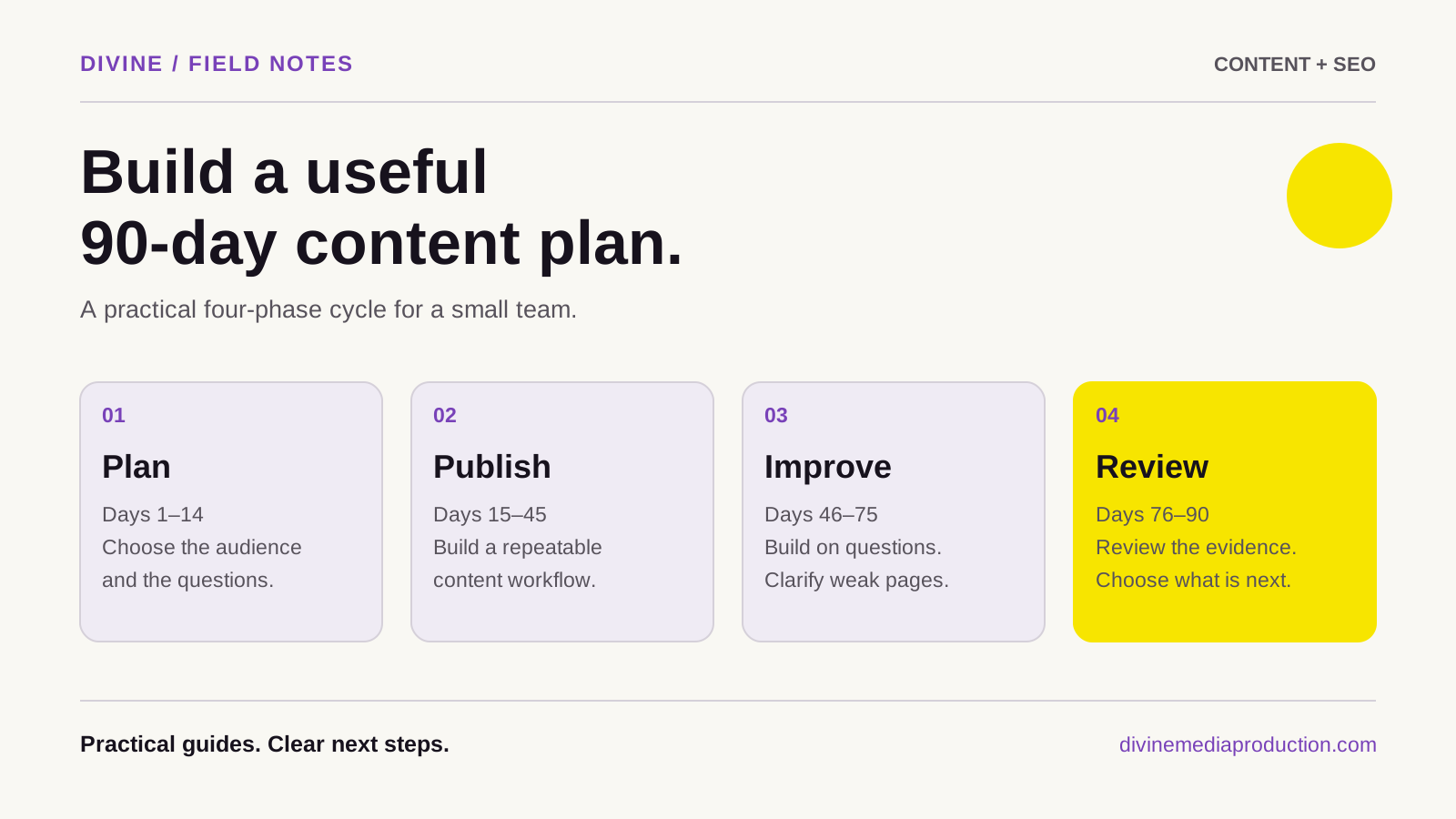
A useful 90-day content marketing plan connects one business goal to a small set of customer questions, assigns time to answer them properly, and reviews what happens next. For a small business, a sustainable starting point is one substantial piece every two weeks, supported by shorter adaptations and regular conversations with prospective customers. Your capacity should decide the schedule.
The aim is to finish the quarter with clearer answers, stronger service information, and evidence about what people need. Ninety days is a planning period, not a promise of search rankings or a deadline for every piece to produce a sale.
Start with one business goal
Choose the commercial problem before choosing a format. A Toronto renovation company might need more inquiries for a particular service. A neighbourhood studio might need to explain an unfamiliar offer. A professional firm might want better-qualified consultations, reducing calls from people it cannot help.
Write a goal in this form: “Help [specific customer] understand [decision] so they can confidently take [next step].” Then define a qualified inquiry. Include the service requested, location you actually serve, project fit, and any essential timing requirement. Avoid treating every message as equally valuable.
Record a baseline using the information you already have: recent inquiries, common objections, search clicks where available, and the pages people mention. If you lack reliable numbers, label the starting point unknown and begin collecting them consistently.
Find questions in real conversations
Collect questions from sales calls, emails, project handovers, customer support, and your own team's explanations. Remove names and private details. Ask the person handling inquiries which misunderstanding repeats most often and which answer usually helps someone make a decision.
Group the questions into three stages: understanding the problem, comparing approaches, and preparing to hire. “Why does this keep happening?” needs a different answer from “What should I send you for an estimate?” A good quarter covers the journey rather than repeating introductory advice.
Prioritize each idea by customer relevance, business relevance, and your ability to provide useful evidence. Google advises creating material for people and contributing something useful beyond a summary of other pages. Treat that as an editorial standard, not a requirement to inflate articles. See its guidance on helpful content.
Fix the destination before increasing distribution
A helpful post needs a sensible next step. Review the relevant service page: does it explain what is included, who the service suits, how the process works, and how to get in touch? Replace vague claims with information a buyer can use.
For businesses serving Toronto and the GTA, location details should reflect actual operations. Explain travel arrangements, consultation options, or project logistics when they matter. Do not add a list of neighbourhood names simply to make the page look local. Our guide to local service pages covers that distinction.
Test the inquiry path on a phone. Someone who understands your article should be able to find the related service and contact method without searching through the navigation.
Divide the quarter into four phases
Use the following structure as a working template. Adjust dates around your busiest delivery periods instead of forcing content production into a week when nobody can review it.
Scroll across to view all columns
| Period | Main job | Useful output |
|---|---|---|
| Days 1–14 | Choose the audience, audit existing pages, collect questions | One-page plan, baseline, six prioritized topics |
| Days 15–45 | Publish and establish a repeatable workflow | Two or three substantial answers and their adaptations |
| Days 46–75 | Build on useful questions and improve weak explanations | Further answers, updated service details, better examples |
| Days 76–90 | Review evidence and decide what deserves another quarter | Keep, improve, stop, and test decisions |
Six substantial topics are a ceiling for this example, not a quota. Four well-reviewed pieces may be the right plan if each requires filming, approvals, or specialist input.
Budget for review and publishing
Content calendars often account for writing while overlooking preparation, approvals, image selection, uploading, and answering responses. Give each job an owner and a time allowance. One person can hold several roles, but the work still exists.
A sample four-hour weekly budget could reserve thirty minutes for customer questions, ninety minutes for drafting or editing, forty-five minutes for review, forty-five minutes for publishing and adaptation, and thirty minutes for follow-up. These are planning allowances, not production-time promises. A detailed video may need a different budget entirely.
If the schedule slips twice, reduce the number of deliverables before adding more channels. Keep a ready-to-publish buffer when possible. Agree on an approval deadline and who can resolve factual questions so a finished draft does not sit untouched for weeks.
Use a repeatable content brief
Before anyone writes or films, complete this short brief:
- Reader and situation: Who needs this answer, and what are they deciding?
- Main question: The single question the piece must answer clearly.
- Direct answer: Two or three sentences stating the useful conclusion.
- Evidence: A demonstration, original example, approved project detail, or reliable source.
- Limits: Circumstances in which the answer changes.
- Next step: A relevant service, checklist, related article, or inquiry.
For example, an explanation of project pricing should identify the factors affecting the estimate rather than inventing a universal price. An approved photo can demonstrate a process; an unsupported “best in Toronto” claim cannot. Use our SEO content brief guide when a topic needs a fuller outline.
Worked example: a small custom-storage business
Consider a fictional Toronto business designing custom storage for compact homes. Its owner can review one substantial piece every two weeks. The goal is to help suitable customers arrive at a consultation with useful measurements and realistic questions.
The first topic explains what to photograph before asking for a consultation. The next compares adjustable shelving with fixed storage. Later pieces cover planning around awkward corners, understanding what changes a quote, preparing the room, and choosing between two layouts. Each answers a different decision instead of rewriting the same sales message.
For the first piece, the owner records a short demonstration in a sample space. An editor turns it into a practical website guide, a concise video showing the measuring sequence, and a photo checklist. All three point to the same consultation preparation page. Real customer spaces appear only with appropriate permission.
The owner records whether inquiries arrive with the requested photographs, which questions still need explaining, and whether the projects fit. If the guide receives little traffic but repeatedly helps existing prospects prepare, that is useful evidence too. The plan can improve sales conversations before search visibility changes.
Distribute with a purpose
Choose one primary social channel where you can participate consistently, then adapt each substantial piece for that audience. A short demonstration, a question-led post, and a practical checklist have different jobs. Repeating the article title three times is not a distribution plan.
Link related website pages using descriptions that tell readers what they will find. Share an article in a customer conversation when it answers the person's question. If you send email updates, use an appropriate permission-based list. Our video repurposing workflow shows how one source can support several useful formats.
Review and adjust every month
Review completed work, customer response, and commercial outcomes together. Search Console can show search impressions, clicks, and queries; those are discovery signals, not a count of leads. Google explains the measures in its performance reporting guide.
At each monthly review, choose one improvement. Clarify a title that attracts the wrong audience. Add an example where readers keep asking the same follow-up. Repair a difficult contact step. Allow enough time to observe the change, and note seasonal events or promotions that could affect the comparison.
Use a simple decision log: what changed, why, when, and what you will check next. Our measurement guide explains how to connect these observations to inquiries without claiming certainty that the data cannot support.
Choose your next practical step
Start with the Toronto content and SEO checklist, select one customer question, and write its brief. If you need help producing the material or maintaining the schedule, explore content creation and social media management, or tell us about your business and available capacity.